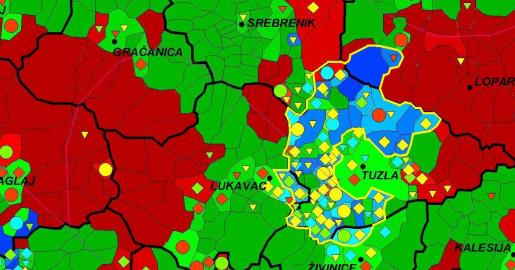
http://www.rgallivan.blogspot.com/Demography was a crucial factor in the war between Bosnian Croats and Muslims of 1992 to 1994. In municipalities that were not under the Serbs’ control and where Croats and Muslims each made up more than a third of the pre-war population, without exception, war broke out between the two ethnic groups.
Fighting also erupted between Croats and Muslims in municipalities where one group was substantially outnumbered by the other, though this was usually related to demographic conditions in neighbouring areas. But in other municipalities that were demographically dominated by either the Croats or Muslims, the two ethnic groups continued to co-exist, avoiding the outright separation that took place elsewhere in Bosnia.
TuzlaPerhaps more than any other part of Bosnia, Tuzla, a city and municipality in northeast Bosnia, withstood the ethnic divisions that plagued much of the rest of the country after war broke out. It fostered common life not just between Croats and Muslims, but with the Serbs as well. The most obvious reason for this is that non-nationalist forces won the elections in the municipality in 1990, but demography may have been an even more important factor.
Although only 48% of Tuzla municipality was declared as Muslim in the 1991 census, the city is considered part of Bosnia’s Muslim heartland along with the cities of Sarajevo and Zenica, because Croats and Serbs and only accounted for 16% and 15% of the municipality’s population respectively. The remainder of the population declared themselves as Yugoslavs. Tuzla’s demographic make-up meant that it was never likely to fall under the control of either the Serbs or Croats during the 1992 to 1995 war.
This was particularly true in the case of the Croats, because they made up even smaller percentages in the municipalities that border Tuzla, whereas Lopare to Tuzla’s northeast was Serb-majority and there was a concentration of Serbs in parts of Tuzla that bordered with Lopare. Due to the Croats' isolation from other Croat-populated areas of the country there was never any serious likelihood of a Croat-Muslim fight over territory in Tuzla or surrounding areas.
Nevertheless, there were tensions between Croats and Muslims in Tuzla and its surrounding municipalities for two reasons. The first was that, though Croats’ minority status ensured that they would not lay claim to Tuzla as Croat territory, in some parts of the municipality they did predominate, and at least to some degree they wanted this to be recognised. Secondly, though Croats and Muslims in the municipality were united in seeking to prevent its fall to the Serbs, when it came to offensive aims, they were very much divided.
The 1991 census shows that half of the Croats in Tuzla municipality lived not in the city but in the surrounding villages and countryside, in contrast to the Muslims and Serbs, who were mostly in urban areas. According to one demographic survey, the Croats were the dominant ethnic group across 150 square kilometres or nearly 50% of Tuzla municipality, against 30% for the Muslims and 20% for the Serbs. Obviously, such figures depend on how you divide the territory and may be arrived at through manipulation, but it is certainly the case that Croats were the biggest ethnic group in many of the non-urban settlements in Tuzla as defined by the 1991 census. For this reason, the Croats hoped to establish their “Croatian Community of Soli” in the municipality in 1992, to some extent with the intention of linking up areas where they predominated. This was a source of tension with Muslims in Tuzla.
In the municipalities that surrounded Tuzla, Croats also tended to be concentrated in certain areas rather than intermingled with the Muslims and Serbs in the towns and elsewhere. Interestingly, the Tuzla-based 115th Brigade of the Croatian Defence Council (HVO), noted for remaining loyal to the Bosnian government even as other HVO Brigades fought against the Bosnian Army (ARBiH), had its origins in a force that emerged in the village of Drinjaca, home to the bulk of Lopare municipality’s Croat population.
Tensions between Croats and Muslims may have been most prevalent in areas of Tuzla where Croats predominated. A Serb intelligence report from February 1995 describes strained relations between the two groups, particularly in the Croat villages of Dokanj and Husino (in Tuzla municipality) and in Bistrac (in Lukavac, the municipality that borders Tuzla to the West).
However, tensions between Croats and Muslims in Tuzla and the surrounding municipalities may have arisen not so much from demographic factors within the municipalities themselves as from the demography of the wider region. Most notably, while the Tuzla-based Second Corps of the Muslim-dominated ARBiH sought to liberate the besieged Muslim enclave of Srebrenica to the southeast of Tuzla, Croats appear to have been much more concerned with simply defending their villages.
Within the Tuzla-based 2nd Corps of the Bosnian Army, there were tensions that were at least in part related to ethnicity. The first commander of the corps, Zeljko Knez, a Croat, was replaced by a Muslim in 1993, having been blamed for failing to do enough the relieve the pressure on the besieged enclave of Srebrenica in eastern Bosnia. A report authored by Bosnian Army commander Rasim Delic in 1996 claims that the 2nd Corps’ efforts in 1992 “were directed towards the corridor, and not toward Srebrenica where more favourable results were more realistic.” The Croat national interest in breaking the corridor that linked Serb territory between eastern and western Bosnia was clear, but there was no Croat interest in any operations in eastern Bosnia.
Tensions between Croats and Muslims in the Tuzla region culminated in the Bosnian government decision to disband the 115th Brigade of the HVO at the end of 1993. The decision was accepted by the leadership of the 115th Brigade because to have started a conflict with the ARBiH 2nd Corps would have been suicidal.
VaresThough the demography of Vares was much more conducive to conflict between Croats and Muslims than in Tuzla, it seems that, as in Tuzla, the main source of conflict in Vares municipality was conditions in the wider region.
With a pre-war population that was 41% Croat and 30% Muslim, Croats and Muslims in Vares co-existed peacefully if warily until June 1993, when Croat refugees from the war with the Muslims in Central Bosnia began moving into the municipality, pressuring Muslims to leave. In October, Ivica Rajic, commander of the Second Operational Group of the Central Bosnia Operative Zone of the HVO, which had control over the Vares’s HVO Bobovac Brigade, arrived in the municipality to assume command and Muslims in the town were abused and pressured to leave. On 23 October, there was a massacre of Muslims in Stupni Do, a village just outside Vares. In early November the Bosnian Army occupied Vares town and the Croat civilians left, retreating into the tiny Dastanko enclave east of Vares.
The ARBiH takeover of Vares has been interpreted as the result of the extremist behaviour of the Croats under the command of Ivica Rajic, destroying the delicate co-existence that had survived in the region and prompting the intervention of the Bosnian Army. However, the 2nd Corps of the ARBiH, now commanded by Hazim Sadic following Zeljko Knez’s removal, had already been seeking to subordinate Vares to its command well in advance of Rajic's arrival. It may have been motivated in part by the desire to protect the Muslim population there, but there were also clear strategic reasons for the takeover. The HVO in Vares had enjoyed warm relations with the Serbs and was not inclined to engage in offensive operations against them, because there had been no significant pre-war Croat population in the surrounding territory occupied by the Serbs. The ARBiH, however, had a clear interest in capturing territory in the region, all of which had had a substantial Muslim population prior to the war. Taking over the Vares enclave allowed to ARBiH to link up its 2nd and 3rd Corps, paving the way for offensives against the Serbs in 1994 and 1995. As in Tuzla, the diverging aims of the Croats in Vares hindered Muslim objectives. But while the HVO in Tuzla could be subjugated peacefully, in Vares, the Croats’ demographic predominance in the municipality meant it could only be achieved by war.
Orasje, Livno, Tomislavgrad, Sarajevo In Tuzla and Vares, to widely varying degrees, conflicts arising from the different military aims of the HVO and ARBiH soured relations between Croats and Muslims. In Orasje, a Croat-majority municipality on Bosnia’s border with Croatia, there was no such conflict, because the territory was indisputably under the control of the HVO. Muslims, who made up 7% of the municipality, but nearly half of the town’s inhabitants according to the 1991 census, fought in the 106th Orasje Brigade of the HVO throughout the war. Orasje was hemmed in against the Croatian border by Serb forces; had this not been the case it could well have been caught up in a Croat-Muslim conflict for control of the wider region. But the otherwise non-descript town of Orasje is one of the few areas in Bosnia to preserve the vestiges of Croat-Muslim co-existence.
The demographic situation in Livno, a municipality on Bosnia’s western border with Croatia, was also conducive to good relations between Croats and Muslims. Its pre-war population was 72% Croat and 15% Muslim so it too was indisputably under the control of the HVO. Muslims fought in the Livno HVO in 1992 and for much of 1993, until it became involved in the Muslim-Croat civil war in central Bosnia and in Herzegovina.
Muslims in the Livno HVO as in other municipalities were disarmed following the eruption of large-scale clashes between the HVO and ARBiH in Herzegovina at the end of June 1993. As military analyst Davor Marijan, a former soldier with the HVO in Livno, told the International Criminal Tribunal for the former Yugoslavia, once relations between Croats and Muslims broke down, the HVO was to become, except in Orasje, “an almost mono-ethnic formation.” In Livno, the breakdown in relations between Croats and Muslims culminated in incidents that followed the Bosnian Army capture of Bugojno, to Livno's east, from the Croats in late July 1993. A report by the European Community Monitoring Mission quotes an Imam in Livno as saying that following the fall of Bugojno there were “provocations, meetings, robberies, closing of shops, against the Muslims” in the town.
But for the clashes that erupted in the much more ethnically-mixed municipalities in central Bosnia and Herzegovina , Muslims might have remained in the Livno HVO in substantial numbers throughout the war. Nevertheless, according to one report by international military observers from October 1993, UN soldiers spoke to three Muslim men who were still fighting for the HVO, suggesting that there was not a complete breakdown in Croat-Muslim relations in the town.
Tomislavgrad, the municipality that separates Livno from central Bosnia, had a similar ethnic make-up, with 87% of its inhabitants declaring themselves as Croats and 11% as Muslims in the 1991 census. As in Livno, but probably to an even greater extent, relations between the two ethnic groups were soured not by its own ethnic composition but its proximity to the more mixed municipalities of central Bosnia and Herzegovina that were disputed between Croats and Muslims.
The partial, but not total, breakdown in relations between the two groups in Tomislavgrad is well-illustrated by the Croatian author Ivo Zanic, who writes: “Although the Bosniaks were on the whole degraded to the rank of second class citizens, there was no systematic destruction of Islamic religious buildings or mass expulsions or murders.”
He notes that unlike in other Croatian-controlled parts of Bosnia the names of streets and squares did not become wholly Croat and Tomislavgrad kept its Ulica Bega Kopcic (Kopcic-bey Street), named after a Muslim.
The demographic balance between Croats and Muslims in Livno and Tomislavgrad was mirrored in the Muslims’ favour in Sarajevo, with Muslims accounting for 49% of population according to the 1991 census and the Croats 7%. As in Livno and Tomislavgrad there was no large-scale fighting between the two groups, but as in Livno and Tomislavgrad, tensions did arise in Sarajevo due to the conflict between Croats and Muslims in central Bosnia.
The HVO in Sarajevo was at least nominally, like the HVO in Vares, under the control of the Second Operational Group of the Central Bosnia Operative Zone of the HVO. The Second Operational Group was based in Kiseljak, a municipality that bordered Sarajevo and was at the heart of Croat-Muslim conflict in central Bosnia. It was commanded by Ivica Rajic, who, as discussed above, was blamed for the Croat-Muslim fighting in Vares. The ARBiH in Sarajevo was understandably wary of the Sarajevo HVO, which was suspected of working in collusion with the Kiseljak HVO and the Serb besiegers. Like the Tuzla HVO, it was disbanded at the end of 1993.
Relations between Croats and Muslims in Sarajevo also soured, although no doubt the claim by Ivan Vulic, a commander of one of the HVO formations in Sarajevo, that “to be a Croat or a Serb in Sarajevo in 1992, and especially in 1993 meant to be, not a second class citizen but a zero class citizen”, was exaggerated. The Croats’ acceptance of Sarajevo as a Muslim city helped to ensure the survival of a significant Croat population there.
Ethnic dominance and multi-ethnicityLooking at the ethnic map from the 1991 census, the link between demography and conflict in Croat-Muslim relations during the Bosnian war is striking. Curiously, the best examples of continued Croat-Muslim co-existence during the Bosnian war are to be found not in evenly balanced municipalities, but in those areas where either Croats or Muslims predominated. Thus in Sarajevo and Tuzla, where Croats were heavily outnumbered by Muslims, relations were relatively good. Muslims fared much better in the Croat-dominated municipalities of Orasje, Livno and Tomislavgrad than in more mixed municipalities in Central Bosnia, such as Kiseljak and Busovaca. In Tesanj, 72% Muslim and 18% Croat according to the 1991 census, the 110th Brigade of the HVO continued to fight on the side of the ARBiH during the Bosnian war. But in nearby Zepce, which was 47% Muslim and 40% Croat and so more evenly balanced, bitter fighting erupted between the 111th HVO Brigade and the ARBiH.
Examining the link between demography and conflict helps to explain the dynamics of the Croat-Muslim civil war of 1992 to 1994 – and could help to prevent conflict between the two groups in the future.